

What Is an Encoder? (Linked to Closed-Loop Vector Control Scenario)
In the context of closed-loop vector control (as discussed in the previous article on “zero-speed torque“), an encoder is a high-precision electromechanical sensor that converts the mechanical motion (rotation or linear displacement) of a motor’s rotor into electrical signals. These signals are then transmitted to the inverter or controller, providing real-time data on the motor’s position, speed, or direction—all of which are critical for achieving precise control such as zero-speed torque.
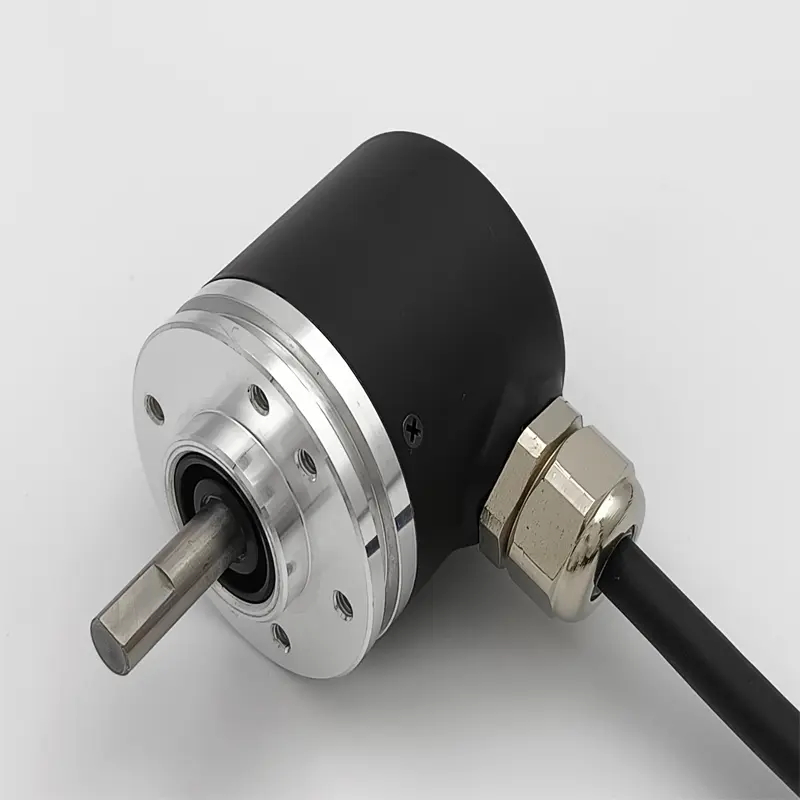
Core Functions of an Encoder (Aligned with Closed-Loop Vector Control)
- Position Feedback:
It captures the exact angular or linear position of the motor’s rotor. For example, in zero-speed torque scenarios, even when the motor is stationary (0 RPM), the encoder continuously outputs position signals (with precision up to 65,536 PPR, or Pulses Per Revolution). This allows the controller to know the rotor’s exact orientation, which is essential for adjusting the magnetic field and current to maintain stable torque.
- Speed Calculation:
By measuring the frequency of position pulses over a fixed period of time, the encoder helps calculate the motor’s real-time speed (RPM). In closed-loop control, this speed data is compared with the target speed to adjust the inverter’s output, ensuring smooth speed regulation—including the transition to zero speed.
- Direction Detection:
Advanced encoders (e.g., incremental encoders with A/B phase signals) can distinguish the rotor’s rotation direction (clockwise or counterclockwise). This is useful for applications like robot joints or lifting equipment, where directional accuracy prevents unintended movement during torque maintenance.
Common Types of Encoders (As Mentioned in Zero-Speed Torque Control)
1. Incremental Encoders
- Working Principle: It outputs a series of pulses as the rotor rotates. To determine the absolute position (e.g., for zero-speed torque initialization), it requires a “homing process” (calibrating to a reference point) when the system starts up.
- Use Case: Suitable for most closed-loop vector control scenarios (e.g., machine tool spindles) where periodic homing is feasible.
2. Absolute Encoders
- Working Principle: It stores the rotor’s absolute position in non-volatile memory. As soon as the system is powered on, it can directly output the exact position without homing—making it ideal for applications where quick startup and continuous position tracking are needed (e.g., robot joints requiring immediate static torque maintenance).
Why Encoders Are Indispensable for Zero-Speed Torque
Without an encoder, open-loop control systems rely on estimated motor parameters (instead of real-time feedback) to adjust the current and magnetic fields. At zero speed, this estimation becomes inaccurate: the motor may fail to generate stable torque (e.g., lifting equipment drifting or robot joints sagging). The encoder’s high-precision feedback solves this issue by allowing the controller to “see” the rotor’s status in real time, enabling the PI (Proportional-Integral) regulator to fine-tune the current and maintain torque even when the motor is not rotating.