
What Is a VFD Motor?
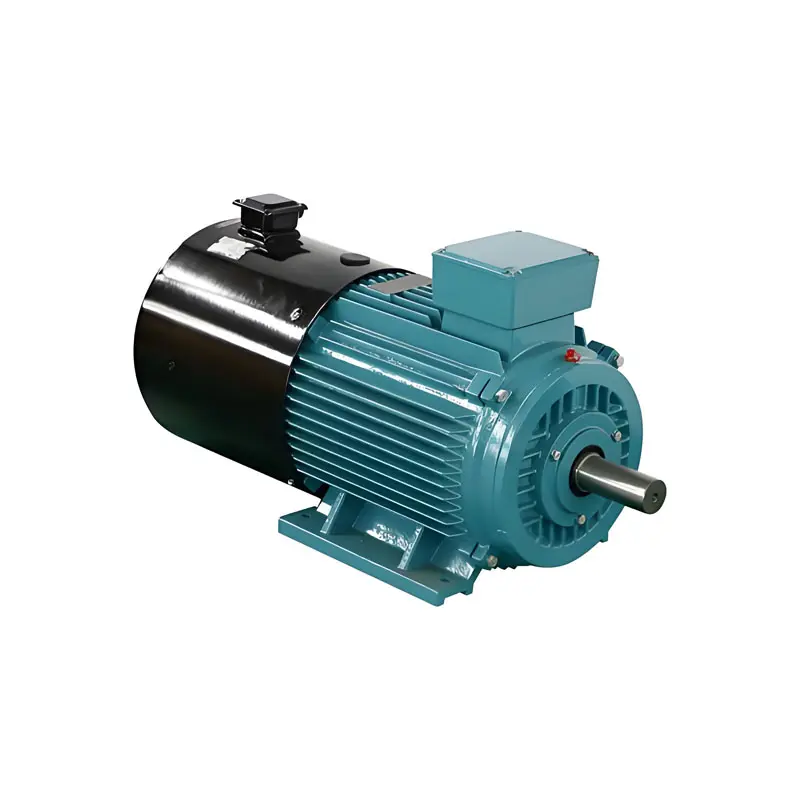
A VFD motor—short for Variable Frequency Drive motor—is also known as a variable-frequency speed-regulating motor or a dedicated inverter motor. It is a type of electric motor specifically designed to work with a variable frequency drive (VFD) to achieve precise speed control. Below is a detailed overview:
How Does a VFD Motor Work?
A VFD motor operates in tandem with a frequency converter (the core component of a VFD system). First, the frequency converter receives the user’s set speed command. It then converts the fixed-frequency alternating current (AC) from the power grid into direct current (DC) and inverts this DC power back into AC power with adjustable frequency and voltage. This modified AC power is then supplied to the VFD motor.
According to the formula \(n = 60 \times f / p\) (where n = motor speed, f = power supply frequency, and p = number of motor pole pairs), adjusting the frequency converter’s output frequency (f) directly changes the motor’s rotational speed (n). This enables stepless speed regulation—meaning the motor can smoothly adjust to any speed within its design range, rather than being limited to fixed speeds.
Key Features of VFD Motors
- High Energy Efficiency: For applications where load torque is proportional to the square of the motor speed (e.g., fans, pumps), VFD motors deliver on-demand power. Unlike traditional systems that use throttle valves or dampers to control output (which wastes energy), VFD motors adjust speed to match the load. This typically results in 20% to 50% energy savings—and sometimes even more.
- Precise Speed Control & Smooth Start/Stop: VFD motors support stepless speed regulation across their set range. During startup, they limit inrush current to within the motor’s rated current, eliminating sudden torque spikes. Start and stop processes are smooth, reducing stress on both the power grid and mechanical equipment. This extends the overall lifespan of the system.
- Superior Control & Protection: VFD motors integrate easily with automatic and remote control systems, making it simple to build closed-loop control setups. These setups stabilize production processes and improve product quality. Additionally, most frequency converters include built-in protection features, such as overvoltage, undervoltage, overload, overheating, and short-circuit protection, to safeguard the motor.
How VFD Motors Differ from Standard AC Motors
VFD motors are not just “standard motors paired with a VFD”—they have specialized designs to handle the unique demands of variable-frequency operation:
- Enhanced Insulation: Frequency converters output PWM (Pulse-Width Modulation) or square waves, which contain high-frequency harmonics. These harmonics cause extra heat and stress in motor windings. To address this, VFD motors use Class F or Class H insulation (higher than the Class B insulation common in standard motors) and optimized winding layouts. This strengthens insulation performance and minimizes harmonic damage.
- Independent Cooling Systems: Standard motors rely on a shaft-mounted fan for cooling, but this fan becomes less effective at low speeds (a common scenario for VFD motors). VFD motors solve this with a separate forced-cooling fan (powered by a small dedicated motor). This ensures consistent heat dissipation across the entire speed range—critical for preventing overheating at low speeds.
- Optimized Electromagnetic Design: VFD motors use advanced electromagnetic designs and high-quality materials to maintain high efficiency across a wide speed range (especially at medium and low speeds). Their structural and electromagnetic schemes are also tuned to reduce electromagnetic vibration and noise—issues that can worsen with variable-frequency power.
Common Applications of VFD Motors
VFD motors are widely used in scenarios that require speed regulation and energy efficiency. Key applications include:
- HVAC systems: Fans in central air conditioners, pumps for chilled/hot water circulation
- Water supply & wastewater: Water distribution pumps, aeration blowers for wastewater treatment
- Industrial machinery: Compressors, conveyor belts (logistics sorting), textile machines, papermaking equipment
- Commercial appliances: High-efficiency washing machines, refrigeration units