
Quick Diagnosis and Repair Manual for Water Pump Faults in Southeast Asia
I. Fault Diagnosis Quick Reference Table
|
Fault Type
|
Typical Symptoms
|
Quick Diagnosis Methods
|
|
Impeller Jam
|
Difficulty starting, abnormal motor noise, sudden current surges
|
After powering off, manually rotate the motor shaft to check for blockages; disassemble the pump body to inspect if the impeller is tangled with debris or scaled.
|
|
Bearing Damage
|
Abnormal noise during operation, excessive machine vibration, overheating of the bearing end cover
|
Touch the bearing area to check temperature (temperatures over 80℃ are abnormal); rotate the shaft to detect excessive clearance or a stuck sensation.
|
|
Shaft Seal Leakage
|
Water leakage from the bottom of the pump body, rust accumulation near the shaft system
|
Check for water droplet residue under the pump body; inspect if the shaft seal rubber components are aged or damaged.
|
|
Motor Overload Burnout
|
Failure to start, circuit breaker tripping, burning odor emitting from the motor
|
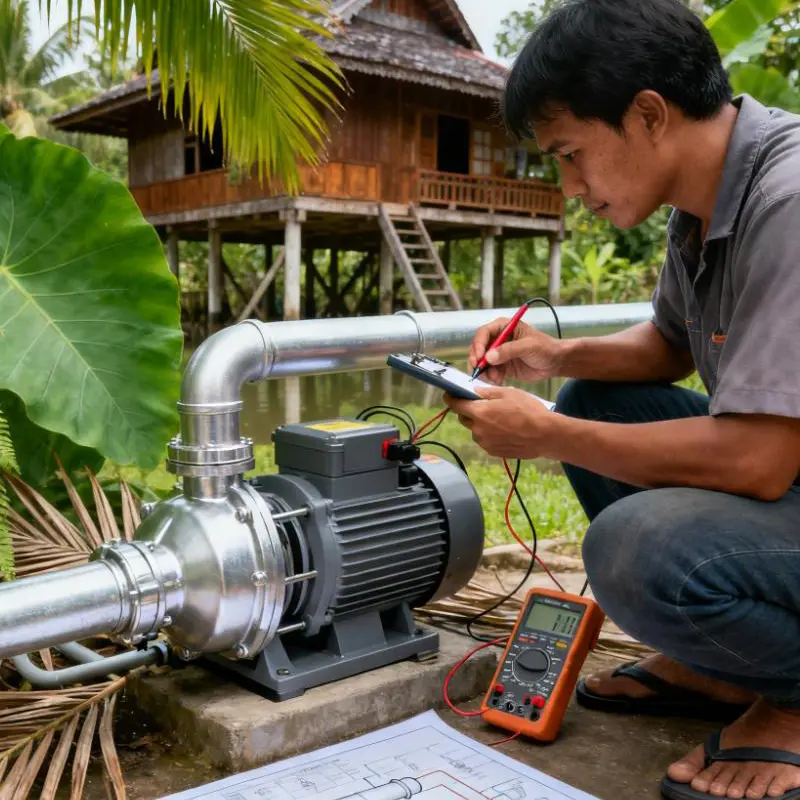
Use a multimeter to test the motor winding resistance; if resistance reads zero, the motor is determined to have short-circuited and burned out.
|
|
Submersible Pump Water Ingress
|
Motor tripping, operational failure, reduced insulation resistance
|
Measure the motor insulation resistance (readings below 2MΩ are abnormal); disassemble the motor to check for internal water stains or rust.
|
|
Insufficient Flow and Head
|
Decreased water output, inadequate water supply pressure
|
Inspect the water inlet pipeline for blockages; check if the impeller is worn, scaled, or damaged.
|
II. On-Site Repair Procedures
(1) Repair for Impeller Jam
- Immediately cut off power and stop the machine, then close the inlet and outlet valves.
- Disassemble the pump body’s end cover and rinse the impeller and flow channel with a high-pressure water gun to remove tangled fibrous debris and sediment.
- Inspect the impeller for damage; replace it with the same model if necessary.
- After reassembly, manually rotate the shaft to ensure there are no blockages before powering on for a test run.
(2) Repair for Bearing Damage
- Remove the motor’s end cover and bearing housing, then take out the damaged bearing.
- Clean impurities and old grease from the bearing housing, then apply high-temperature resistant lithium-based grease (suitable for Southeast Asia’s high-temperature environments).
- Ensure the new bearing is installed correctly to avoid eccentricity during installation.
- After reassembly, test the motor to confirm it rotates smoothly without abnormal noise before putting it into use.
(3) Repair for Shaft Seal Leakage
- Disassemble the pump body and remove the aged or damaged shaft seal assembly.
- Replace it with a new shaft seal that meets specifications, ensuring the sealing surface is clean and free of debris during installation.
- Apply a small amount of sealant to the sealing surface to improve sealing performance.
- Conduct a pressure test after reassembly to ensure no leakage before operating the pump.
(4) Repair for Submersible Pump Water Ingress
- Remove the submersible pump from the water, disassemble the motor housing, and clean internal water stains and rust.
- Check if the winding insulation layer is damaged; if so, rewind the windings or replace the motor as needed.
- Replace all aged seals to ensure the sealing structure is intact.
- After reassembly, perform insulation and waterproof tests; only return the pump to water for use if it passes both tests.
III. Localized Preventive Measures for Southeast Asia
- Install multi-layer filters (pore size ≤2mm) at the water inlet and clean them 1–2 times per week to prevent sediment and algae from entering the pump body.
- Choose corrosion-resistant pump bodies made of stainless steel or engineering plastics to adapt to saline water in coastal areas and fertilizer-contaminated water in agricultural irrigation.
- Replace high-temperature resistant grease every 3 months to prevent lubrication failure caused by Southeast Asia’s hot and humid climate.
- Use a variable frequency drive (VFD) with a wide voltage input range (180–240V) to handle power supply fluctuations, and enable overload protection and overheating protection functions.
- Inspect the sealing condition of submersible pumps before the rainy season and replace aged seals promptly.
- Install rain shields for outdoor motors to prevent insulation degradation from rainwater erosion.
IV. Recommended Tools and Wear-Prone Spare Parts
(1) Essential Repair Tools for On-Site Use
Digital multimeter, high-pressure water gun, bearing puller, adjustable wrench set, insulation resistance tester, manual pressure pump.
(2) Common Wear-Prone Spare Parts
High-temperature resistant lithium-based grease, shaft seal assemblies (various sizes), precision bearings, nylon filter screens, industrial-grade sealant, motor winding insulation paint.