

VFD Parameters to Check During Motor No-Load Operation
During the motor no-load operation phase, checking the parameters of a Variable Frequency Drive (VFD) is a core step to verify equipment compatibility and operational stability. Focus should be placed on three key categories: output electrical parameters, protection function parameters, and control mode & frequency parameters, as detailed below:
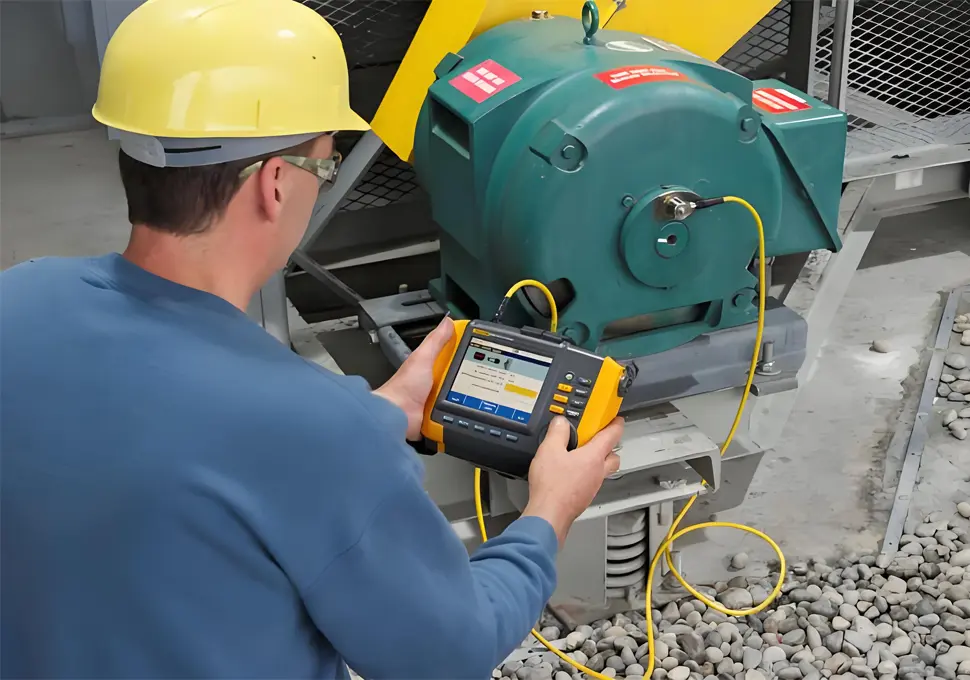
I. Output Electrical Parameters (Real-Time Monitoring Category)
These parameters require real-time observation throughout no-load operation to ensure no abnormal fluctuations or threshold violations. They are critical for evaluating the VFD’s output performance:
- Output Three-Phase Current
-
- Core Requirement: The three-phase current must be balanced (unbalance degree ≤10%, calculated as: (Maximum current – Minimum current)/Average current × 100%), and the no-load current must align with the motor’s specifications (typically 20%~50% of the motor’s rated current).
-
- Key Check Points: No significant current fluctuations during operation (fluctuation range ≤5% of the motor’s rated current) and no instantaneous peak current (to prevent triggering overcurrent protection).
- Output Three-Phase Voltage
-
- Core Requirement: The three-phase voltage must be symmetrical (voltage difference ≤5% of the VFD’s rated output voltage), and the voltage waveform should closely resemble a sine wave (no severe distortion or abnormal harmonics; an oscilloscope can be used for auxiliary detection).
-
- Key Check Points: In V/F control mode, voltage must change proportionally to the output frequency (e.g., 50Hz corresponds to the rated voltage, while 10Hz corresponds to 20% of the rated voltage), with no sudden voltage spikes or drops.
- DC Bus Voltage
-
- Core Requirement: During stable operation, the DC bus voltage fluctuation range must be ≤±5% of the rated value (e.g., for a VFD with 380V input, the DC bus voltage typically ranges from 510V to 540V, and fluctuations must be controlled within 25V).
-
- Key Check Points: No threshold-exceeding voltage surges in the bus during start-stop phases (e.g., no voltage spikes during shutdown to avoid triggering overvoltage protection).
- VFD Module Temperature
-
- Core Requirement: The module temperature must be ≤60℃ (at an ambient temperature of 40℃), and the internal cabinet temperature must be ≤50℃. It should remain at least 10℃ below the VFD’s “overheating” alarm threshold (typically 70~85℃).
-
- Key Check Points: No continuous upward temperature trend; when the cooling fan operates normally, the temperature should stay within a reasonable range.
II. Protection Function Parameters (Configuration & Verification Category)
Before no-load operation, confirm that protection parameters are configured correctly. During operation, verify the effectiveness of these functions to prevent false alarms or failures caused by improper parameter settings:
- Overcurrent Protection Parameters
-
- Configuration Requirement: The protection set value is typically 1.5~2 times the motor’s rated current (during the no-load phase, ensure the set value is not less than twice the no-load current to avoid false triggering).
-
- Verification Method: Simulate a slight overcurrent (e.g., current rises to 1.2 times the set value) and check if the VFD trips within the set time to confirm the protection function responds normally.
- Overvoltage/Undervoltage Protection Parameters
-
- Configuration Requirement: The overvoltage protection threshold is usually 1.1~1.2 times the grid’s rated voltage, while the undervoltage protection threshold is 0.8~0.9 times the grid’s rated voltage (must match the fluctuation range of the on-site input power supply).
-
- Verification Method: During no-load operation, if the input power voltage fluctuates within ±10% of the rated value, the VFD should not trigger “overvoltage” or “undervoltage” alarms and must maintain stable output.
- Overload Protection Parameters
-
- Configuration Requirement: During no-load operation, the motor load rate is low. The overload protection current set value should be no less than 1.1 times the motor’s rated current, and the protection time can be extended appropriately (to avoid false triggering due to short-term current fluctuations).
-
- Verification Method: During no-load operation, if the current temporarily rises to 1.1~1.2 times the set value, the VFD should not trip immediately and must follow the set overload delay logic.
- Phase Loss Protection Parameters
-
- Configuration Requirement: The phase loss protection function is enabled by default, with a response time set to ≤5 seconds (to ensure the motor stops quickly in case of phase loss and prevent winding burnout).
-
- Verification Method: Temporarily disconnect the wiring of one motor phase during no-load operation and observe if the VFD alarms and cuts off output within 5 seconds to confirm the protection function works effectively.
III. Control Mode & Frequency Parameters (Basic Configuration Category)
These parameters must be configured before no-load operation. During operation, verify that the actual output matches the settings, as they impact the motor’s operational accuracy:
- Control Mode Parameters
-
- Configuration Requirement: V/F control mode is commonly used for no-load commissioning (the “V/F curve type” parameter should be set to “linear” or “quadratic” to match the characteristics of asynchronous motors); for vector control mode, “motor parameter self-learning” must first be completed (accurately input the motor’s nameplate parameters, such as rated power, rated current, and stator resistance).
-
- Verification Method: In V/F mode, the motor speed changes linearly with frequency; in vector control mode, the no-load speed error is ≤1% of the motor’s rated speed, with no “loss of step” issues.
- Output Frequency Parameters
-
- Configuration Requirement: The upper limit frequency for no-load operation is usually set to the motor’s rated frequency (e.g., 50Hz). The acceleration time is set to 10~30 seconds (adjusted based on motor power to avoid impact from sudden speed changes), and the deceleration time should not be shorter than the acceleration time.
-
- Verification Method: During operation, the deviation between the actual output frequency and the set frequency is ≤0.5Hz (e.g., when set to 50Hz, the actual frequency should range from 49.5Hz to 50.5Hz), with no frequency drift (drift ≤0.1Hz per hour).
- Start-Stop Control Parameters
-
- Configuration Requirement: The start mode is set to “step-by-step frequency-up start” (to avoid direct full-frequency start), and the stop mode is set to “step-by-step frequency-down stop” (output is cut off after the frequency drops below 5Hz).
-
- Verification Method: No current impact during start-up (peak current ≤1.5 times the motor’s rated current), no voltage fluctuations during shutdown, and the motor stops smoothly (no runaway or sudden stops).
IV. Key Notes for Parameter Checking
- Parameter Reading Method: Prioritize reading real-time parameters via the VFD’s local operation panel or upper computer monitoring system. Avoid relying solely on theoretical configuration values—actual operation data must be used for verification.
- Abnormal Handling Principle: If parameters exceed thresholds (e.g., current unbalance degree >10%, module temperature >70℃), stop the equipment immediately, investigate the cause (e.g., loose wiring, incorrect parameter configuration), and re-commission only after resolving the issue. Forced operation with faults is prohibited.
- Recording Requirement: Record the stable values of key parameters during no-load operation (record once every 10 minutes, with at least 3 sets of data), including output current, voltage, frequency, and temperature. These records serve as a reference for subsequent load commissioning.