

Why Is the Inverter Fan Not Working? Causes and Impacts on the Inverter
I. Common Causes of an Inverter Fan Not Working
The inverter fan is a core heat dissipation component, and its failure to rotate is usually related to power supply issues, hardware faults, control logic errors, or the external environment. Specific causes can be categorized as follows:
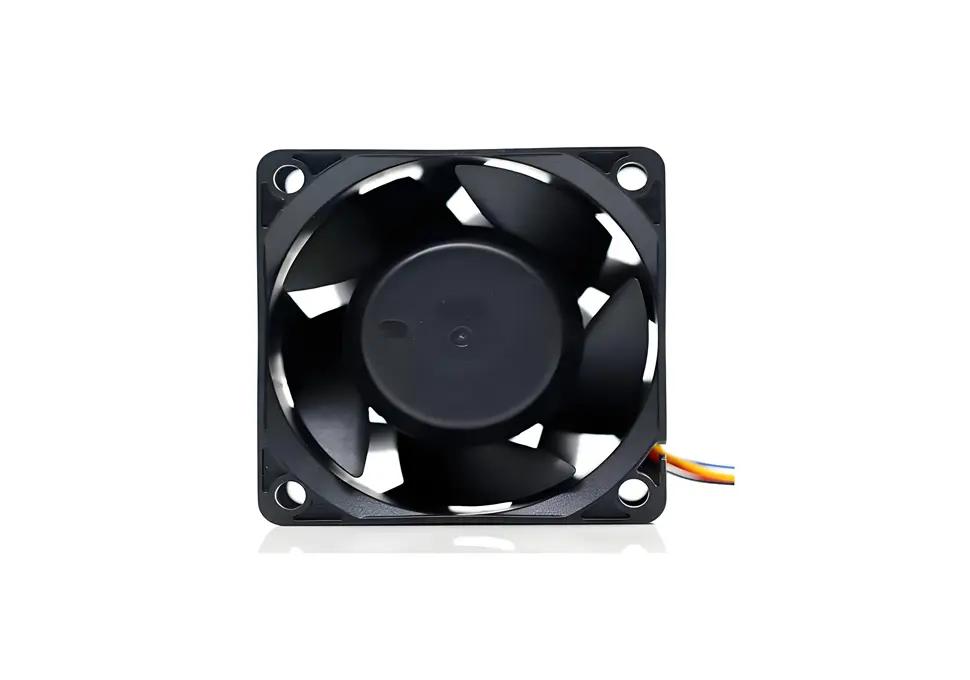
1. Power Supply and Circuit Failures (Basic Troubleshooting Items)
- Broken fan power supply circuit: The fan is generally powered by the inverter’s internal auxiliary power supply (e.g., DC12V/24V). If the fuse in the power supply circuit blows, the terminal is loose, or the wire is broken, the fan will have no power input and stop rotating. For example, the fan power supply circuit of some inverters is in series with a small fuse, which may blow due to overload after long-term use.
- Faulty auxiliary power module: If the inverter’s internal auxiliary power supply (which powers the fan and control circuit) is damaged (e.g., capacitor bulging, chip burnout), it will directly cut off the fan’s power supply. This issue may also be accompanied by phenomena such as no display on the panel and abnormal control signals.
2. Fan Hardware Damage (High-Frequency Fault Points)
- Burnt fan motor: When the fan operates continuously for a long time, its motor windings may short-circuit or open due to insulation aging and bearing wear. Judgment method: After powering off the inverter, use a multimeter to measure the resistance of the fan motor windings. If the resistance is infinite (indicating an open circuit) or close to 0Ω (indicating a short circuit), the motor is damaged.
- Jammed fan bearings: Lack of oil in the fan bearings, excessive dust accumulation, or long-term wear will cause the rotor to jam and fail to rotate. Symptoms include significant resistance when manually rotating the fan blades (or blades that cannot rotate at all), and in some cases, a “buzzing” abnormal sound after power-on—even though the blades do not rotate.
- Fallen or loose fan connection wires: The connection plug (e.g., terminal block, DuPont connector) between the fan and the inverter may become loose due to vibration or aging, preventing current from being transmitted to the motor.
3. Control Signal or Logic Failures (Easily Overlooked Causes)
- Abnormal temperature control signal: Most inverters use “temperature-linked control” for fans—the fan starts only when the internal temperature reaches a set threshold (e.g., 40℃). If the temperature detection component (e.g., NTC thermistor, temperature sensor) is damaged, it will mistakenly judge that the temperature does not meet the standard, causing the fan to never start. Alternatively, the relay or transistor that controls the fan’s start and stop may fail, preventing it from receiving the start signal.
- Incorrect program parameter settings: Some inverters support setting the fan to “manual start/stop” or “automatic start/stop” through parameters (e.g., “fan operation mode”). If the parameter is mistakenly set to “manual off,” or the automatic start/stop threshold is set too high (e.g., set to 60℃ when the actual temperature does not reach this level), the fan will not rotate.
4. External Environment or Usage Habit Issues
- Blocked fan air inlets or outlets: If the inverter is used for a long time in an environment with heavy dust and oil (e.g., workshops, mines), dust and oil dirt will block the dust filter at the fan’s air inlet or the air outlet itself. This blockage causes the fan to stop due to poor heat dissipation and overload, or the blades may get stuck by foreign objects.
- Long-term overload operation of the fan: If the inverter operates under conditions exceeding its rated load for a long time (e.g., frequent motor overload, ambient temperature exceeding 50℃), the fan must run at high speed continuously to dissipate heat. This accelerates motor aging and bearing wear, eventually leading to premature damage.
II. Severe Impacts of a Non-Rotating Fan on the Inverter
The core components of the inverter (e.g., IGBT power module, rectifier bridge, capacitor) generate large amounts of heat during operation. The fan is a key component for forced heat dissipation—when it stops rotating, heat cannot be dissipated, triggering a series of chain failures:
1. Frequent Inverter Overheating Alarms (Direct Consequence)
When the fan stops rotating, the internal temperature of the inverter rises rapidly. Once it reaches the protection threshold (usually 50~70℃), the built-in overheating protection circuit will trigger an alarm (e.g., displaying fault codes such as “OH” or “OL”) and cut off the output power. This causes the motor to stop, disrupting the production process. If not addressed promptly, the alarm will recur, making normal operation impossible.
2. Sharply Reduced Service Life of Power Modules (Core Hazard)
Power modules such as IGBTs are the “heart” of the inverter. Their service life has an exponential relationship with operating temperature: for every 10℃ increase in temperature, the service life is shortened by approximately 50%. After the fan stops rotating, the temperature of the power module will continuously exceed the safe range (e.g., exceeding 80℃), accelerating the aging of the module’s insulation layer. Eventually, this may cause a short circuit due to thermal breakdown, resulting in module burnout. The cost of replacing an IGBT module usually accounts for 30%~60% of the total inverter maintenance cost.
3. Premature Failure of Capacitors and Other Components (Hidden Hazard)
The electrolytic capacitors and film capacitors inside the inverter are sensitive to temperature. Long-term high temperatures cause the capacitor electrolyte to volatilize, reduce capacitance, and increase leakage current—ultimately leading to capacitor bulging and bursting. Capacitor failure destabilizes the DC bus voltage, causing issues such as output voltage fluctuations and motor jitter. In severe cases, it may also damage other control chips.
4. Expanded Overall Inverter Failure (Most Severe Consequence)
If the inverter is not shut down promptly after the fan stops rotating, continuous high temperatures will damage multiple components simultaneously. For example, a short circuit in the power module will burn out the rectifier bridge, which in turn trips the main power supply. Excessively high temperatures may also melt the insulation layer of wires, causing an internal short circuit. Eventually, the entire inverter may be scrapped, and in extreme cases, safety accidents such as fires and electric shocks may occur.