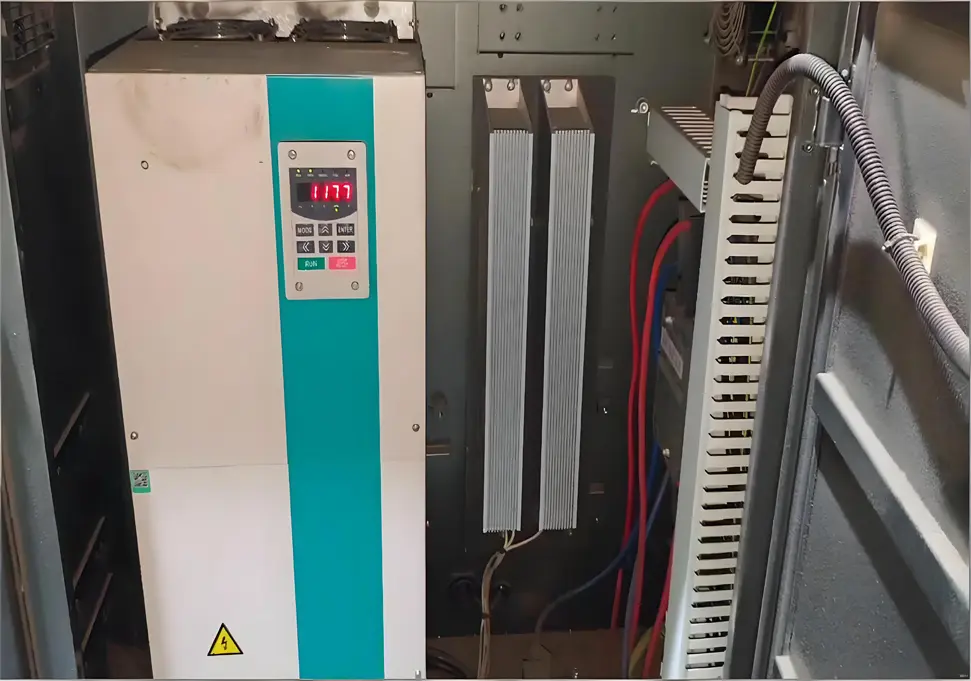
DC braking is a critical function in variable frequency drives (VFDs) that applies direct current to the motor stator windings, creating a stationary magnetic field. This generates braking torque on the rotating rotor, enabling precise and rapid motor stopping when needed.
- Material handling systems: Conveyor belts requiring accurate positioning
- Elevator systems: Precise floor leveling and emergency stopping
- CNC machinery: Accurate spindle positioning for machining operations
- Packaging equipment: Registration control for label application
- Centrifuges: Medical and industrial applications needing quick stops
- Pump systems: Emergency shutdown for fluid control
- Fan applications: Rapid air flow reduction in critical environments
- Printing presses: Quick changeover between production runs
- Crane and hoist systems: Preventing load drift when stationary
- Inclined conveyors: Stopping material slide on angled surfaces
- Elevator doors: Maintaining position during power interruptions
- Assembly lines: Precise stopping during production processes
- Automated guided vehicles: Reducing maintenance on mechanical brakes
- Textile machinery: Eliminating wear on friction components
- Food processing equipment: Improving hygiene by reducing mechanical parts
- Robotics systems: Enhancing positioning accuracy and reliability
- DC brake start frequency: Typically 2-10Hz below rated speed
- Brake activation trigger: Frequency-based, time-based, or external signal
- Transition smoothness: Adjust ramp times to prevent mechanical shock
- DC brake voltage level: 10-30% of motor rated voltage
- Braking current magnitude: 20-80% of motor rated current
- Current rise/fall times: 0.1-2 seconds for smooth transitions
- Overcurrent threshold: Typically 150-200% of rated current
- Thermal protection: Monitor inverter and motor temperatures
- Brake duration limit: Prevent overheating with time restrictions
- Stop accuracy tolerance: 0.1-1 revolution depending on application
- Repeatability settings: For consistent stopping performance
- Load compensation: Adjust for varying inertia requirements
- Duty cycle limitations: Avoid continuous braking applications
- Cooling requirements: Ensure proper ventilation for heat dissipation
- Temperature monitoring: Implement thermistor or thermocouple protection
- Current handling capacity: Verify inverter can supply braking current
- Voltage rating compatibility: Match with motor specifications
- Dynamic braking requirements: Consider external braking resistors if needed
- Torque limitations: Avoid exceeding mechanical design constraints
- Vibration analysis: Check for resonance issues during braking
- Load inertia matching: Adjust parameters based on load characteristics
- PLC communication: Coordinate with control systems
- Safety interlocks: Implement proper emergency stop functions
- Feedback systems: Consider encoder feedback for precision applications
Example 1: Conveyor System Braking
- DC brake voltage: 20% of rated voltage
- Braking current: 40% of rated current
- Start frequency: 5Hz
- Braking duration: 2 seconds
- Application: General material handling
Example 2: Precision Positioning Application
- DC brake voltage: 25% of rated voltage
- Braking current: 60% of rated current
- Start frequency: 2Hz
- Braking duration: 1 second
- Additional: Encoder feedback for 0.1 revolution accuracy
Example 3: High-Inertia Load Braking
- DC brake voltage: 30% of rated voltage
- Braking current: 80% of rated current
- Start frequency: 10Hz
- Braking duration: 3 seconds
- Additional: External braking resistor required
- Excessive motor heating: Reduce braking duty cycle or increase cooling
- Incomplete stopping: Increase braking current or duration
- Mechanical shock: Adjust current rise/fall times
- Parameter instability: Check for electromagnetic interference
Proper implementation of DC braking can significantly enhance system performance, reduce maintenance requirements, and improve safety. Always consult the manufacturer’s documentation and consider application-specific requirements when configuring parameters.