

Can Frequency Converters Be Connected to Leakage Protectors? Comprehensive Guidelines
1. Core Compatibility Logic: Why Do Ordinary Leakage Protectors Fail?
The high-frequency switching characteristics of frequency converters generate two types of special currents, which cause false tripping of traditional leakage protectors:
- Harmonic Leakage Current: The high-frequency switching (typically in the kHz range) of IGBT modules produces a large number of 3rd and 5th harmonics. These currents easily leak through the cable-to-ground capacitance. AC-type leakage protectors can only detect sinusoidal leakage currents and cannot identify harmonic components, which directly triggers false tripping.
- Stray Capacitive Current: There is distributed capacitance between the frequency converter’s output cables, the ground, and the motor housing. Under high-frequency voltages, capacitive currents (usually in the mA range) are generated; these superimpose on normal leakage currents and exceed the leakage protector’s operating threshold.
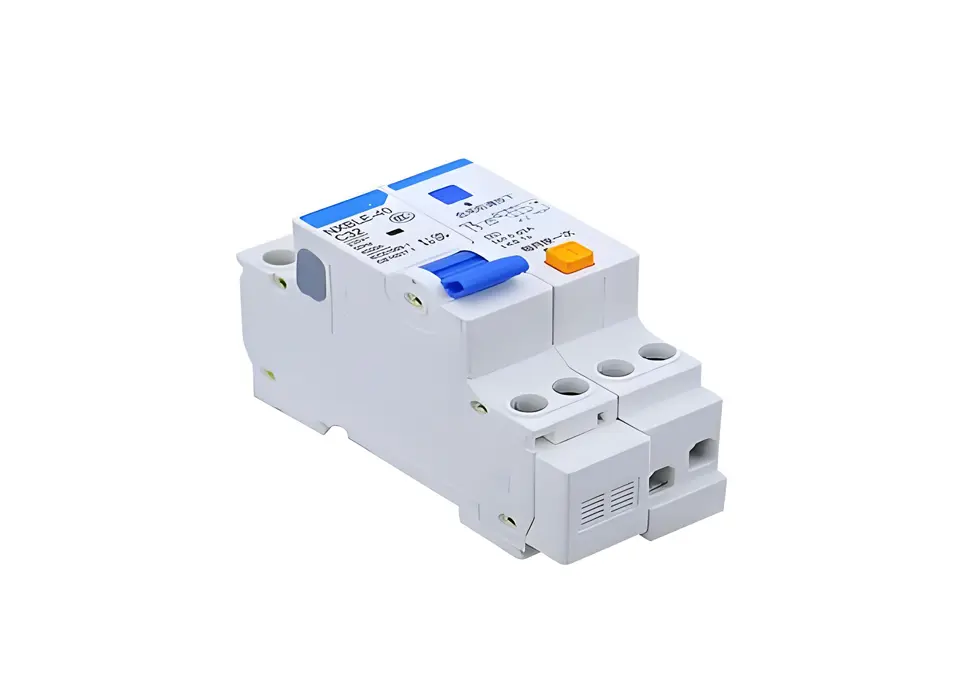
Therefore, it is necessary to select types (Type A/Type B) that are compatible with non-sinusoidal leakage currents. Their key differences are as follows:
|
Leakage Protector Type
|
Applicable Scenarios
|
Detectable Leakage Current Types
|
Compatibility in Frequency Converter Scenarios
|
|
Type AC
|
Pure power-frequency equipment (e.g., ordinary motors, heaters)
|
Sinusoidal AC leakage current
|
Not recommended (false tripping rate > 80%)
|
|
Type A
|
Equipment with pulsating DC (e.g., frequency converters, rectifiers)
|
Sinusoidal + pulsating DC leakage current
|
Recommended for general scenarios (compatibility: 70%)
|
|
Type B
|
Equipment with high-frequency harmonics/smooth DC
|
Sinusoidal + pulsating DC + high-frequency harmonic leakage current
|
Recommended for complex industrial scenarios (compatibility: 95%)
|
2. Installation and Configuration: Details Determine Stability
1. In-depth Logic of Installation Location
- Installation on the Input Side (Grid Side): This is the preferred option, as it only detects leakage current on the grid side and avoids harmonic interference from the frequency converter. It is recommended to install the leakage protector between the main circuit breaker and the frequency converter’s input filter, forming a protection chain: “Grid → Leakage Protector → Frequency Converter → Motor”.
- Installation on the Output Side (Motor Side) Is Prohibited: The output side contains high-frequency harmonics and capacitive currents; even Type B leakage protectors have a false tripping rate of over 30%. Additionally, leakage currents caused by motor faults (e.g., winding grounding) are first addressed by the frequency converter’s internal protection mechanism, rendering the leakage protector ineffective and even disrupting normal operation.
2. Precise Matching of Parameter Selection
- Leakage Operating Current (IΔn):
-
- Civil/small equipment (e.g., laboratory motors): 30mA (personal safety is a top priority)
-
- Industrial heavy-duty equipment (e.g., pumps, fans): 50–100mA (balances false tripping prevention and protection)
-
- Large units (e.g., frequency converter power > 110kW): 100–300mA (requires matching equipment housing grounding resistance ≤ 4Ω)
- Operating Time (tΔ):
-
- Individual motor circuits: ≤ 0.1s (enables rapid equipment protection)
-
- Shared frequency converter circuits for multiple motors: 0.1–0.5s (avoids false triggering by transient currents)
- Rated Current (In): Must be 1.2–1.5 times the rated input current of the frequency converter to prevent the leakage protector from overheating and tripping falsely.
3. Key Requirements for Wiring and Grounding
- Cable Separation: Input cables (R/S/T) and output cables (U/V/W) should be routed through separate conduits with a spacing of ≥ 30cm; bundling them together is prohibited (this reduces stray currents caused by harmonic coupling).
- Grounding Specifications:
-
- The frequency converter housing, motor housing, and leakage protector grounding terminal must be connected to the same grounding electrode, with a grounding resistance of ≤ 4Ω (for industrial scenarios) or ≤ 10Ω (for civil scenarios).
-
- Multi-strand copper-core grounding wires should be used, with a cross-section of ≥ 2.5mm² (for leakage protectors with a rated current ≤ 63A) to prevent leakage current from failing to discharge due to poor grounding.
- Capacitance Suppression: Connect an EMC filter (equipped with a common-mode inductor + Y capacitor) in parallel at the frequency converter’s input end to suppress harmonic leakage to the grid side and reduce the likelihood of the leakage protector triggering.
3. Prohibited Scenarios and Handling of Special Working Conditions
1. Absolutely Prohibited Scenarios
- Connecting contactors/relays in series between the frequency converter and the leakage protector (frequent on-off operations generate inrush currents, which trigger false tripping of the leakage protector).
- Using a single leakage protector for multiple frequency converters (harmonic superposition from each frequency converter easily causes leakage current to exceed limits).
- Having an excessive distance (> 10 meters) between the leakage protector and the frequency converter (this increases cable-to-ground capacitance and raises stray currents).
2. Solutions for Special Working Conditions
- Long Cable Scenarios (output cable > 50 meters): Cable-to-ground capacitive current increases significantly; a dV/dt filter must be installed on the motor side to suppress capacitive current. Additionally, increase the leakage protector’s operating current to above 100mA.
- High-Frequency Working Conditions (frequency converter carrier frequency > 10kHz): Harmonic leakage current intensifies; Type B leakage protectors must be used. Also, reduce the carrier frequency (5–8kHz is recommended, while considering motor noise tolerance).
- Multi-Motor Parallel Scenarios: Equip each motor with an independent thermal relay, and install a unified leakage protector at the frequency converter’s input end to avoid overall tripping caused by a single motor fault.
4. Troubleshooting Common Problems and Solutions
|
Fault Phenomenon
|
Core Cause
|
Solution
|
|
Frequent false tripping of the leakage protector
|
1. Incorrect type selected (Type AC used); 2. Excessively low operating current (< 30mA); 3. Cross-interference from wiring
|
1. Replace with Type A/Type B; 2. Increase the operating current to 50–100mA; 3. Rewire and separate input/output cables
|
|
Leakage protector fails to trip (during equipment grounding fault)
|
1. Leakage protector installed on the output side; 2. Excessively high grounding resistance (> 10Ω); 3. Damaged leakage protector
|
1. Relocate to the input side for installation; 2. Rectify the grounding system to reduce grounding resistance; 3. Replace the leakage protector and test
|
|
Severe heating of the leakage protector
|
1. Insufficient rated current; 2. Loose terminal connections; 3. Internal component loss caused by harmonic interference
|
1. Replace with a leakage protector with a larger rated current; 2. Tighten terminals and apply conductive paste; 3. Install an input filter
|