

How Closed-Loop Vector Control Achieves “Zero-Speed Torque” with an Encoder
The core of how closed-loop vector control achieves “zero-speed torque” lies in using high-precision position and speed feedback from an encoder, which enables the inverter to precisely control the magnetic field and current even when the motor is stationary—thereby generating stable torque.
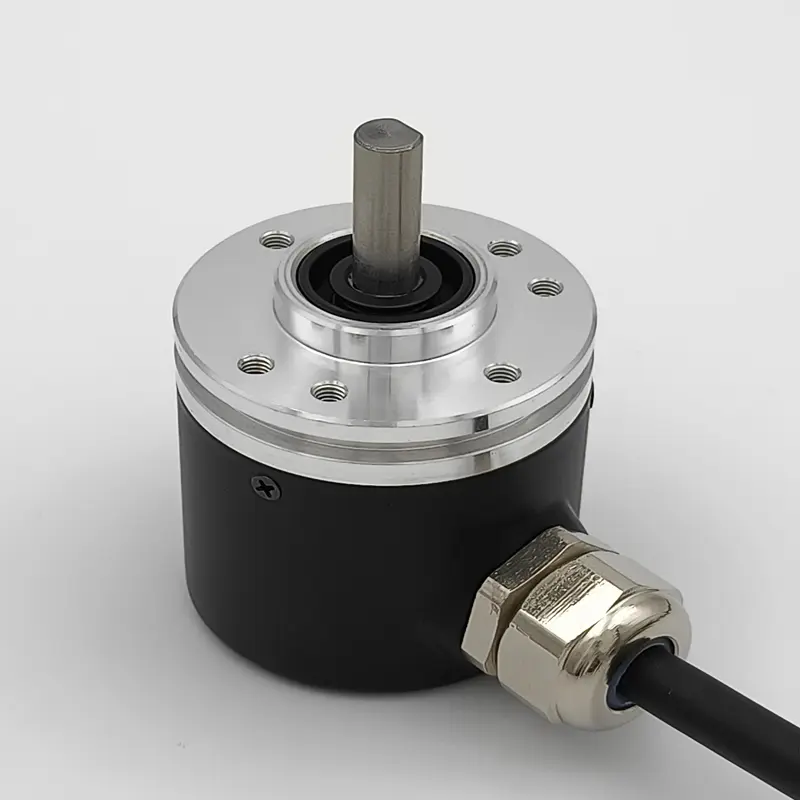
Working Principle
1. The Key Role of the Encoder
- Provides real-time rotor position information (with precision ranging from 1024 to 65536 PPR)
- Calculates the number of pole pairs and electrical angle to enable field-oriented control
- Continuously outputs position signals even at 0 RPM (revolutions per minute)
2. Control Implementation Process
- Field-Oriented Control: Decomposes the motor current into excitation current components and torque current components, allowing independent regulation of magnetic field and torque.
- Zero-Speed Strategy:
- When the motor speed approaches zero, the control mode switches from the speed loop to the position loop to enhance position stability.
- A small position deviation is set as the source of the torque command to trigger torque output without causing motor rotation.
- The PI (Proportional-Integral) controller outputs current commands in real time, adjusting the torque current component to maintain stable torque.
3. Key Technical Parameters
- Encoder Type: Incremental encoders (require homing to determine absolute position) or absolute encoders (position is known immediately after power-on)
- Control Cycle: High-speed computation with a cycle of 100–200 µs (microseconds)
- Torque Response Time: Typically less than 10 ms (milliseconds)
- Low-Speed Performance: Capable of stable operation at speeds as low as 0.01 RPM
Application Scenarios
- Tension control in printing machines and paper machines (maintains constant tension when materials are stationary)
- Hover function in lifting equipment (keeps loads stable without drifting when stopped)
- Static torque maintenance in robot joints (prevents joint sagging during positioning)
- Stationary clamping of machine tool spindles (secures workpieces tightly during machining)
Common Issues and Solutions
- Vibration Problems: Optimize PI controller parameters to reduce overshoot, or add a low-pass filter to suppress high-frequency interference.
- Encoder Installation Issues: Ensure coaxial alignment between the encoder and the motor shaft, and minimize mechanical clearance to avoid position signal errors.
- Homing Process Challenges: Perform motor parameter identification (such as stator resistance and inductance testing) before the first startup to improve homing accuracy.