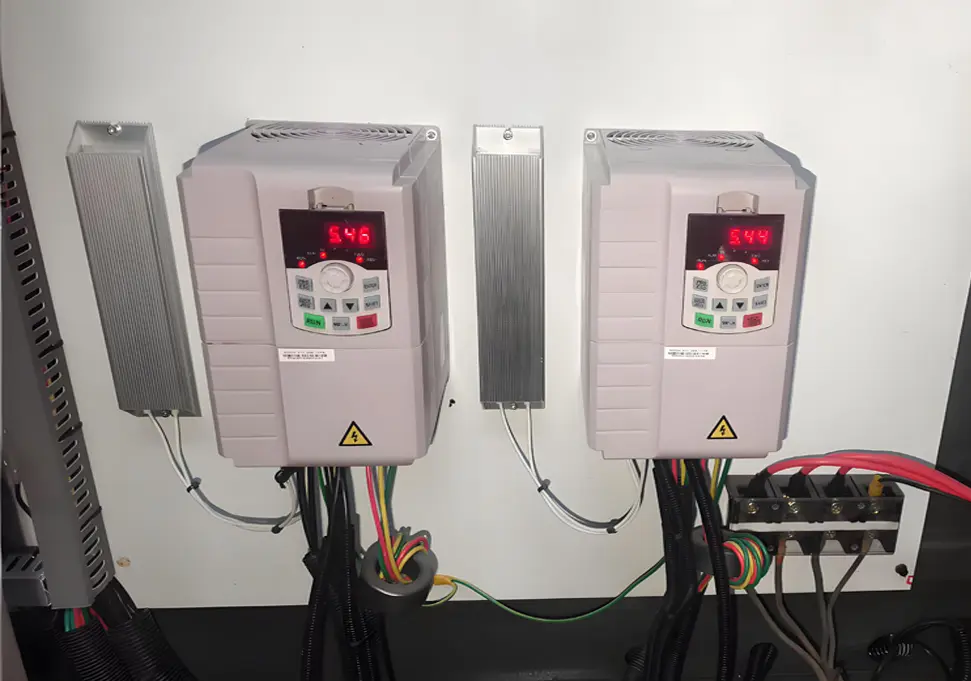
This question is highly practical. Below are the ten core advantages of variable frequency speed regulation, covering key scenarios such as energy conservation, control, and operation and maintenance:
When a motor operates at a non-rated speed, its energy consumption is proportional to the cube of the speed. Variable frequency speed regulation accurately matches load requirements, eliminating energy waste from the “big horse pulling a small cart” phenomenon. The energy-saving rate reaches 20%-50% in most applications.
It offers a wide speed regulation range (typically above 1:100) and enables continuous, smooth speed adjustment. It meets precise speed demands under different working conditions, far exceeding the adjustment accuracy of traditional methods like pole changing and voltage regulation.
Adopting a soft-start method, the starting current can be controlled within 1.2 times the rated current. This avoids the large current impact during power frequency startup, reduces wear on motor windings and mechanical transmission components, and extends equipment service life.
It enables remote control and automatic speed adjustment via PLCs, touch screens, and other devices. It supports multi-speed operation and PID closed-loop control (e.g., pressure and flow closed-loop control), making it suitable for complex industrial automation scenarios.
The large current from power frequency startup causes grid voltage fluctuations, affecting other electrical equipment. Variable frequency soft start prevents this issue and ensures stable grid operation.
Precise speed control ensures consistent production parameters (such as flow, pressure, and tension). It minimizes product quality fluctuations, especially for high-process-demand scenarios like assembly lines, chemical production, and printing.
Frequency converters come with built-in protection mechanisms, including overload, overcurrent, overvoltage, phase loss, and overheating protection. They monitor motor status in real time and shut down quickly during abnormalities to prevent equipment damage.
It is compatible with various motor types, including asynchronous and synchronous motors. It supports constant torque, constant power, and variable torque loads (e.g., pumps, fans, machine tools, and conveyors), with applications across industrial, construction, transportation, and other sectors.
Smooth speed regulation and startup reduce equipment vibration and noise, improving the working environment while minimizing impact wear on mechanical transmission systems (such as gears and couplings).
It supports fault self-diagnosis, parameter storage, and retrieval functions, enabling quick problem localization when faults occur. There is no need to frequently replace wearing parts like starters and speed-regulating resistors, reducing maintenance frequency and labor input.