

What Is a Submersible Pump?
A submersible pump is a water-pumping device that operates with its pump body directly immersed in water. It is primarily used to extract liquids from deep wells, pools, rivers, lakes, and other water sources, and is widely applied in agricultural irrigation, industrial drainage, urban water supply, household drainage, and emergency rescue scenarios.
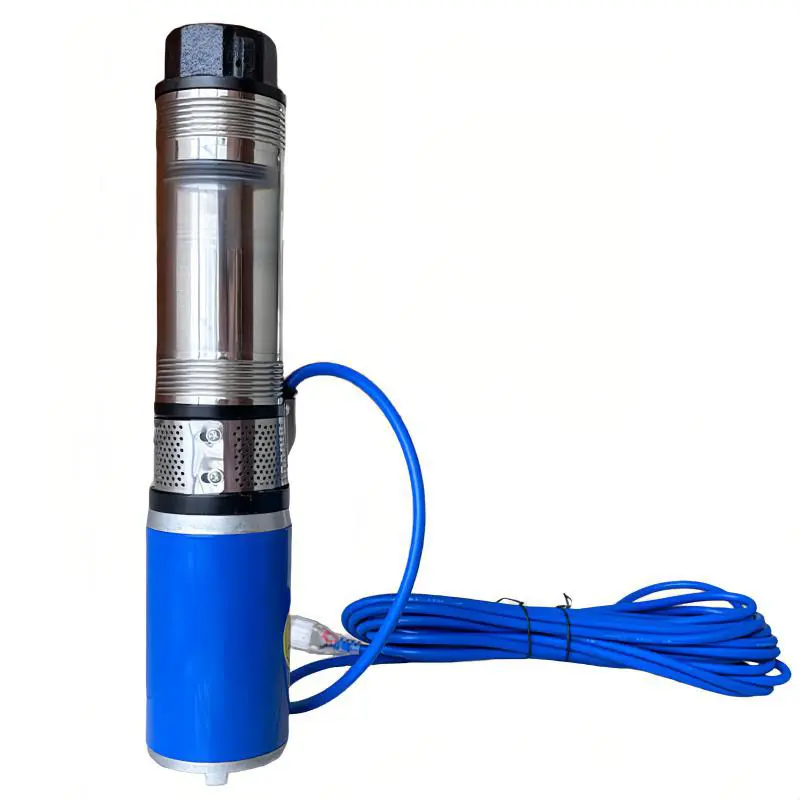
Structural Features of Submersible Pumps
- Integrated design: The motor and pump are typically assembled into a single unit, eliminating the need for additional transmission components (such as couplings or drive shafts). Its compact structure allows for easy immersion in water.
- Waterproof sealing: The motor is equipped with robust waterproof sealing measures (e.g., mechanical seals, O-rings) to prevent water from entering the motor, which could cause short circuits or damage.
- Submersible operation: During operation, the entire pump body (including the motor) is fully submerged in liquid. This design uses the liquid to cool the motor while reducing suction-related inefficiencies, thereby improving pumping performance.
Working Principle of Submersible Pumps
When a submersible pump starts, the motor drives the impeller to rotate at high speed. Under centrifugal force, liquid within the impeller is propelled toward the impeller’s edge, creating a low-pressure zone at the impeller’s inlet. External atmospheric pressure then pushes liquid from the water source through the suction pipe into the impeller. The liquid is continuously expelled and transported to the desired location via the outlet pipe.
Types of Submersible Pumps
Based on application scenarios and structural differences, submersible pumps fall into several categories:
- Deep-well submersible pumps: Ideal for extracting water from deep wells. Their slender design enables them to adapt to deep water levels.
- Sewage submersible pumps: Specifically engineered to handle sewage, sludge, and other impurity-laden liquids. Their impellers and pump bodies feature anti-clogging designs.
- Clean-water submersible pumps: Used for pumping clean water or liquids with minimal contaminants, making them common in households, agriculture, and similar settings.
- Mining submersible pumps: Designed for mine drainage, with explosion-proof and wear-resistant properties to withstand harsh working conditions.
Advantages of Submersible Pumps
- Easy installation: No need for a dedicated pump house—simply submerge the pump in water to operate, saving space and installation costs.
- High efficiency: Submersible operation reduces pipeline losses and air leakage, resulting in higher pumping efficiency compared to many land-based pumps.
- Low noise: Since the pump operates underwater, the water absorbs noise, minimizing operational sound.
When using a submersible pump, avoid dry running (operating when the pump is not submerged) and regularly inspect the sealing performance and impeller wear to extend its service life.